
This new DNWA engined Audi RS3 is here for some bolt on mods and Stage 2 tuning.
For any potential of releasing power from the RS3 or any Audi RS engine, you need a few components.
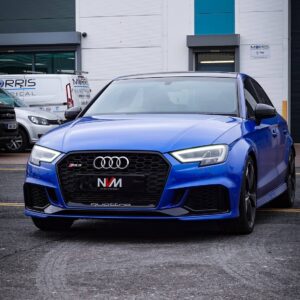
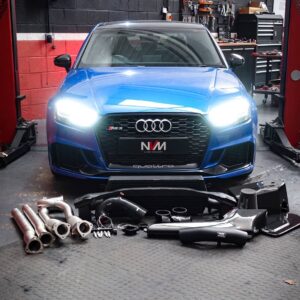
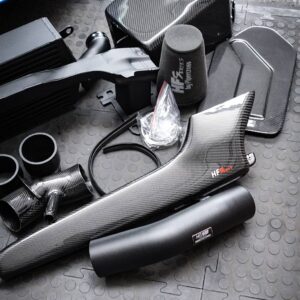
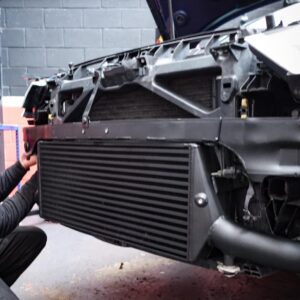
We have gone for carbon fibre intake with Forge Inlet elbow, Forge intercooler and downpipe. Also we have upgraded the NGK spark plugs as well.
The DNWA engines are a little quieter than the previous DAZA engines, but a change of exhaust and a couple of alterations in the ECU when tuning, we can add a little overrun improve the sounds.
A Comparison of the original parts to the performance upgrades, showing a much larger intercooler for better cooling and cone air intake system comparing to the OEM version allowing more air intake.
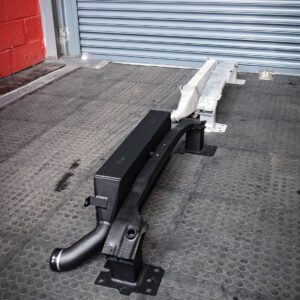

After fitting of the parts it was time to get it back on the dyno and strapped down ready for further testing and to get some base figures with the additional parts.
Baseline power: 400 BHP
Baseline Torque: 519 Nm
After looking at the datalogs at about 6,000 rpm the actual throttle body closes and that is because the increasing flow from the turbo elbow, intake and intercooler actually created overboost and is governed by the ECU, so as soon as the ECU sees it, it closes it.
So this is something we look to change and increase boost pressure so the ECU doesnt close it.
After initial base tuning run we are seeing 494 BHP and 666 Nm of torque, that is boosting to 1.6 bar.
After tuning to the modifications of the intercooler, intake and turbo elbow with the stock exhaust the results are as follows.
 NVM Power: 516 Bhp
 NVM Torque: 720 Nm
Also the gearbox map was done to aid the torque limiters, so an increase from the base run of 116 BHP and an impressive 201 Nm of torque with a nice smooth power curve.
Note this is with the stock exhaust so with a change of exhaust system to a full unrestricted system and possibly some octane booster we can add ignition timing and see a further increase of 15-20 BHP.